Every report carries a boat condition score from 0 to 100. The number is built from the answers recorded during the inspection, with higher-risk items carrying more weight. Here is exactly how the boat health score is calculated, so you can explain it to an owner without guessing.
Two things determine the score
A checkpoint like “Aft bilge pump and float switch” has two parts. Its weight says how much it matters, and that weight does not change between boats or visits. Its state comes from the answer the technician records during today's inspection. Keeping weight and state separate means the consequence of the item and today's finding each have a clear job in the score.
State has three answers: Pass earns full credit, Watch earns half, and Action earns none. There is no N/A. A boat without a Seakeeper does not get Seakeeper checkpoints. Its equipment profile determines which equipment-driven checkpoints appear, so equipment the boat does not carry is not part of the score.
Weight comes from consequence, not cost
Every checkpoint sits in one of four tiers, and the test for the tier is always the same question: what happens if this is wrong?
- Tier 1, Critical, weight 10. The consequence can be sinking, fire or someone getting hurt. Examples include bilge pumps and float switches, fire suppression and lifejacket count.
- Tier 2, Major, weight 6. The boat can be stranded, or the repair can run into real money. Examples include engine and generator strainers, navigation lights and the windlass.
- Tier 3, Moderate, weight 3. Costs money if it is left, but the boat is still safe. Examples include A/C performance, tank levels and the head.
- Tier 4, Cosmetic, weight 1. Something is noticed, but nothing breaks. Examples include the Bimini top and interior lighting.
A Pass on a Tier 1 item and a Pass on a Tier 4 item do not carry the same weight. Each checkpoint earns its tier weight in full for Pass, half for Watch, and nothing for Action. The Condition score is the points earned divided by the applicable points, shown out of 100.
Not checked is not Pass
A checkpoint the technician did not answer is Not checked. It is excluded from both the points earned and the applicable points, not counted as Pass. Coverage shows the share of checks actually answered, so the report makes clear how much of the checklist the score is based on.
What happens when a critical item is in Action
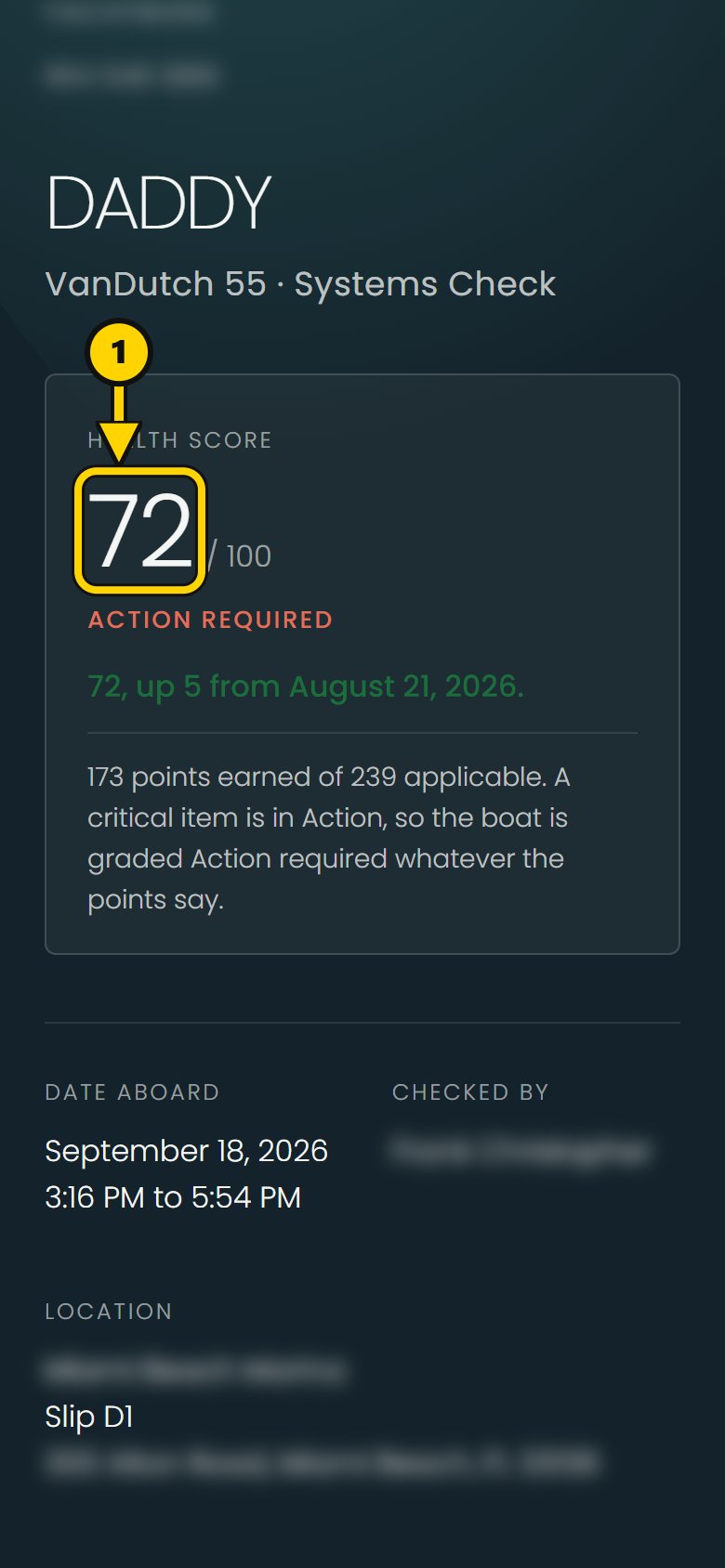
Weighting alone does not tell the whole story. Two failed bilge float switches and an expired fire suppression system can still leave a boat with most of its points if most of the checklist is Pass. The arithmetic can put the score in the high seventies even while critical findings need action.
So one rule sits on top of the arithmetic: if any Tier 1 checkpoint is in Action, the overall status is Action required, whatever the score. The real score still shows, say 79 out of 100, with Action required beside it. The number is never capped. When the critical item is cleared on a later inspection, the score can reflect the recorded answers from that visit. This keeps the numerical score separate from the rule that a critical Action makes the overall status Action required.
Bands
| Range | Band |
|---|---|
| 90 to 100 | Good standing |
| 75 to 89 | Watch |
| Below 75, or any Tier 1 in Action | Action required |
The trend adds context to the number
When there is a previous visit to compare against, the report shows the change as well as the current score: “88, down 4 from last month, stern thruster moved from Watch to Action.” The change is colored so an owner can see at a glance whether the boat's score moved up or down. The health score page has more on how that trend is built into every visit; what changed between visits covers how that shows up in the report itself.
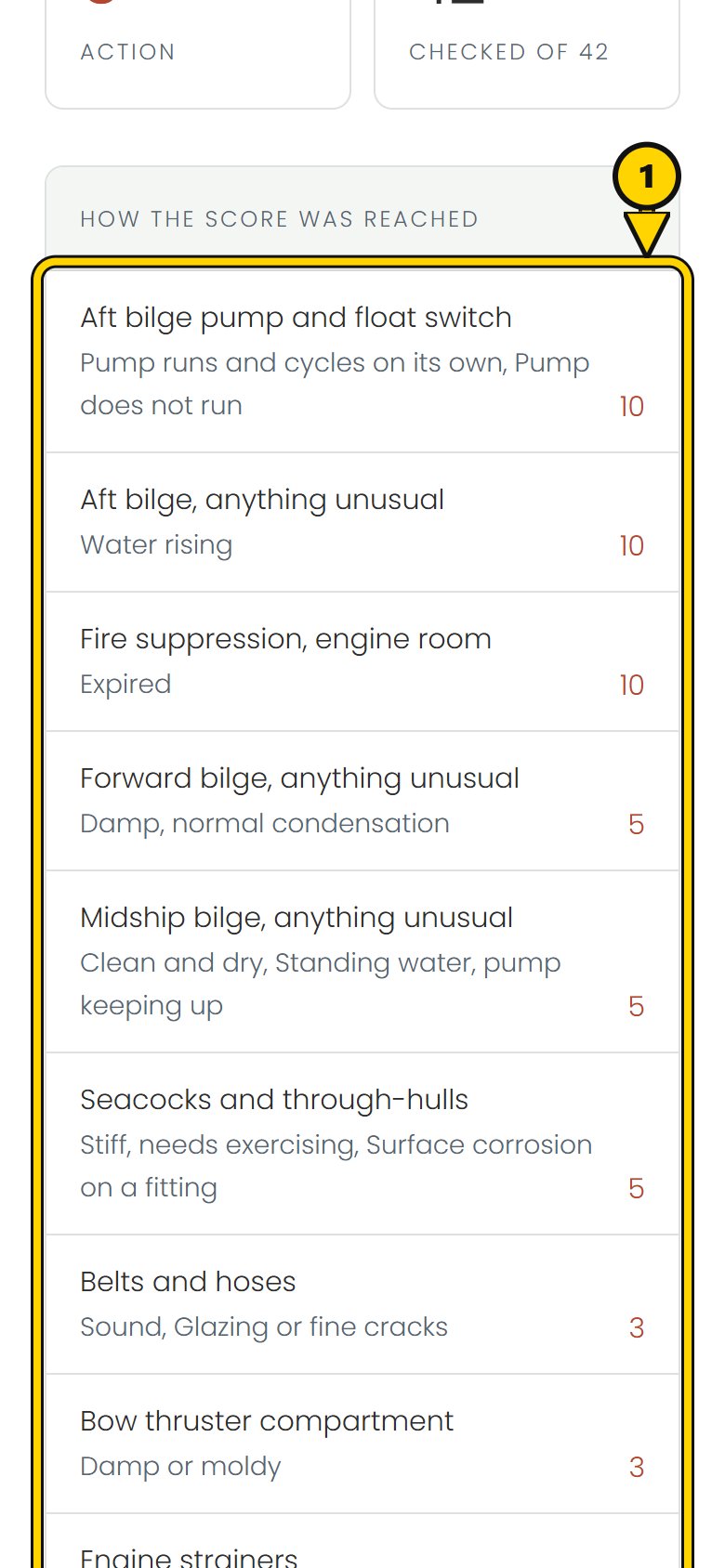
Every point lost is also itemized on the report: the checkpoint, the option the tech picked, its tier, and how many points it cost, with a photo attached to the finding. An owner, a captain or a buyer can take the number apart line by line, because at some point one of them will try.
Common questions
How is a boat's health score calculated?
Each answered checkpoint earns its tier weight in full for Pass, half for Watch, and nothing for Action. The score is the points earned divided by the applicable points, shown out of 100. Equipment the boat does not carry is not part of the calculation. Not checked items are excluded rather than counted as Pass.
Why can a boat show Action required with a high score?
Because the score and overall status are separate. If any Tier 1 item, such as a bilge pump, fire suppression or lifejacket count, is in Action, the overall status is Action required whatever the score. The score itself is not capped.
Can two different boats' scores be compared to each other?
Only loosely, because the applicable checkpoints depend on what each boat carries. A boat with no generator is not scored on generator checkpoints. The score is more useful for following the same boat over time, which is what the trend on its report shows.
The full checklist a score is built from is described on the checklists page; how a completed report presents the score to an owner is on the reports page.
More how-to guides
YachtGrade was designed by a USCG 100-ton captain who spent five years managing, detailing, running and selling boats in South Florida, after four years building IT systems for businesses. Who built it →